Material: Zinc Selenide (ZnSe)
Basic Info
ZnSe is a light yellow binary solid compound that is rarely occurs in nature. It can be made in hexagonal and cubic crystal structures. Zinc selenide is used as a blue light source in light-emitting diodes and diode lasers. It is also used as infrared laser gain medium and as an infrared optical material. ZnSe activated with tellurium is used in x-ray and gamma ray detectors as a scintillator. [9]
Crystal Structure
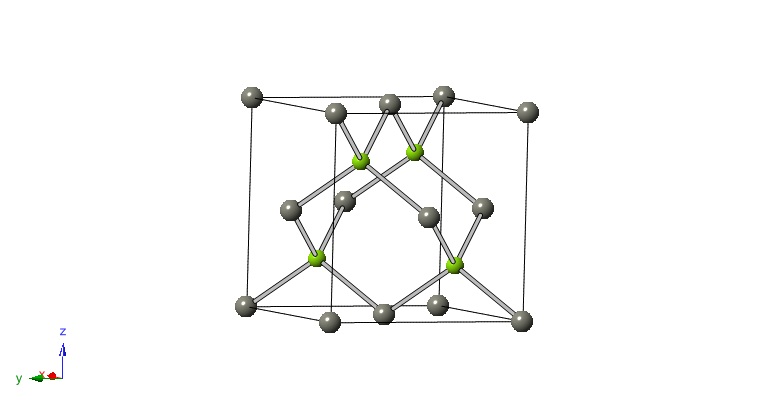
| Fractional Coordinates | Orthogonal Coordinates | |||||||
|---|---|---|---|---|---|---|---|---|
| Label | Elmt | x | y | z | xor[Å] | yor[Å] | zor[Å] | |
| 1. | T2 | Se | 0.2500 | 0.2500 | 0.2500 | -0.863 | -1.331 | -1.873 |
| 2. | T2 | Se | 0.2500 | 0.7500 | 0.7500 | 0.100 | -3.980 | -4.722 |
| 3. | T2 | Se | 0.7500 | 0.7500 | 0.2500 | -2.657 | -1.164 | -5.453 |
| 4. | T2 | Se | 0.7500 | 0.2500 | 0.7500 | -3.482 | -4.171 | -2.935 |
| 5. | T1 | Zn | 0.0000 | 0.0000 | 0.0000 | 0.000 | 0.000 | -0.000 |
| 6. | T1 | Zn | 0.0000 | 0.5000 | 0.5000 | 0.963 | -2.649 | -2.849 |
| 7. | T1 | Zn | 0.5000 | 0.5000 | 0.0000 | -1.794 | 0.167 | -3.580 |
| 8. | T1 | Zn | 0.5000 | 0.0000 | 0.5000 | -2.620 | -2.841 | -1.063 |
| 9. | T1 | Zn | 1.0000 | 0.0000 | 0.0000 | -5.376 | -0.025 | -1.793 |
| 10. | T1 | Zn | 1.0000 | 0.5000 | 0.5000 | -4.414 | -2.674 | -4.642 |
| 11. | T1 | Zn | 0.0000 | 1.0000 | 0.0000 | 1.788 | 0.358 | -5.366 |
| 12. | T1 | Zn | 0.5000 | 1.0000 | 0.5000 | -0.831 | -2.482 | -6.429 |
| 13. | T1 | Zn | 1.0000 | 1.0000 | 0.0000 | -3.588 | 0.333 | -7.159 |
| 14. | T1 | Zn | 0.0000 | 0.0000 | 1.0000 | 0.137 | -5.656 | -0.332 |
| 15. | T1 | Zn | 0.5000 | 0.5000 | 1.0000 | -1.657 | -5.490 | -3.912 |
| 16. | T1 | Zn | 1.0000 | 0.0000 | 1.0000 | -5.239 | -5.681 | -2.125 |
| 17. | T1 | Zn | 0.0000 | 1.0000 | 1.0000 | 1.925 | -5.298 | -5.698 |
| 18. | T1 | Zn | 1.0000 | 1.0000 | 1.0000 | -3.451 | -5.323 | -7.491 |
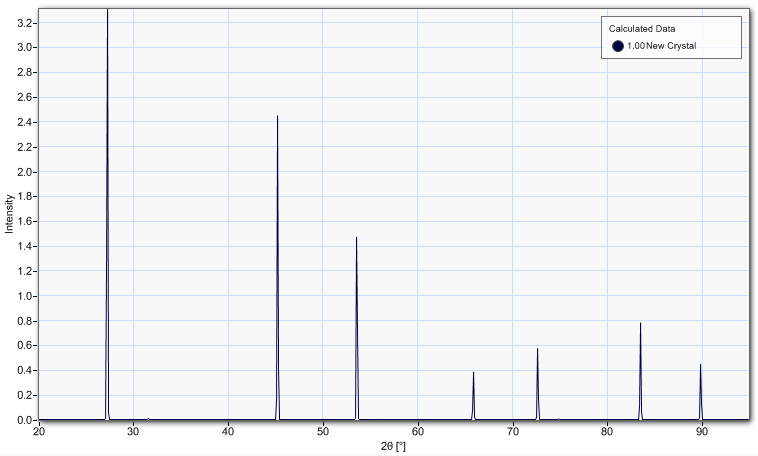
Theoretical diffraction data using a Cu Kα monochromatic source.
(m is the multiplicity and N is the maximum number of flexions)
| ref no. | h | k | l | d(hkl) | 2-Theta | Intensity | I/Imax | m | N |
|---|---|---|---|---|---|---|---|---|---|
| [ 1] | 1 | 1 | 1 | 3.27219 | 27.2296 | 3.56799e-001 | 100.0 | 8 | 3 |
| [ 2] | 0 | 0 | 2 | 2.83380 | 31.5438 | 1.03393e-003 | 0.3 | 6 | 4 |
| [ 3] | 0 | 2 | 2 | 2.00380 | 45.2123 | 2.62259e-001 | 73.5 | 12 | 8 |
| [ 4] | 1 | 1 | 3 | 1.70885 | 53.5827 | 1.57080e-001 | 44.0 | 24 | 11 |
| [ 5] | 2 | 2 | 2 | 1.63610 | 56.1706 | 3.14514e-004 | 0.1 | 8 | 12 |
| [ 6] | 0 | 0 | 4 | 1.41690 | 65.8603 | 4.10933e-002 | 11.5 | 6 | 16 |
| [ 7] | 1 | 3 | 3 | 1.30024 | 72.6539 | 6.12994e-002 | 17.2 | 24 | 19 |
| [ 8] | 0 | 2 | 4 | 1.26731 | 74.8585 | 6.43795e-004 | 0.2 | 24 | 20 |
| [ 9] | 2 | 2 | 4 | 1.15689 | 83.4861 | 8.34838e-002 | 23.4 | 24 | 24 |
| [ 10] | 1 | 1 | 5 | 1.09073 | 89.8496 | 4.77530e-002 | 13.4 | 32 | 27 |
| [ 11] | 0 | 4 | 4 | 1.00190 | 100.4906 | 3.01446e-002 | 8.4 | 12 | 32 |
PV Applications
ZnSe thin films are prepared primarily by molecular beam epitaxy, chemical vapor deposition, chemical vapor deposition, and vacuum evaporation. Electrodeposition is a simple, low cost and a viable method for producing good quality films.[2]
ZeSe films prepared by chemical vapor deposition have a buffer layer that has reached total area efficiencies of up to 9.6% (under AM 1.5 illumination), an open circuit voltage of 482 mV, a short circuit current of 31.0 mA/cm2 and a fill factor reaching 64%. [8]
Basic Parameters at 300 K
| Crystal structure: | Sphalerite | [1] |
| Group of symmetry: | F-43m | [1] |
| Number of atoms in 1 cm3: | 4.39*1026 | [1] |
| Unit cell volume: | 182.05 Å3 | [1] |
| Atoms per unit cell: | 8 | [1] |
| Debye temperature: | 339(2) K | [7] |
| Density: | 5.266 g/cm3 | [1] |
| Dielectric constant (static): | 8.6 | [10] |
| Dielectric constant (high frequency): | 5.7 | [10] |
| Effective electron masses: | (0.16 ± 0.01)me | [3] |
| Effective hole masses: | 0.75 mo | [7] |
| Lattice constant: | a = 5.667 Å | [1] |
| Optical phonon energy (longitudinal): | 0.0314 eV | [5] |
| Conductivity: | n-type | [3] |
Temperature Dependences
Graph of electron concentration vs temperature may be found in M. Aven, High Electron Mobility in Zinc Selenide Through Low Temperature Annealing. J. Appl. Phys. 42, 1204 (1971); doi: 10.1063/1.1660167 [5]
Donors and Acceptors
Donors: Al, Cl, Ga, In, F, Br [3],[4]
Acceptors: Cu, Ag, Sb [4]
Ionization energy of shallow donors [7]
Ed(LiI) 15(1) meV T= 4.2 K
Ed(NaI) 16(1) meV
Ed(Al) 26.3 meV
Ed(Ga) 27 meV
Ed(In) 28.1 meV
Ed(F) 29.3 meV
Ed(Cl) 26.1 meV
Ed(I) 30.4 meV
Ionization evergy of shallow acceptors
Ea(Li) 118(2) meV T = 4.2 K
Ea(Na) 98(2) meV
Ea(K) 94(2) meV
Ea(N) 112 meV T = 4.2 K
Ea(P) 80…92 meV T = 4.2 K
Ea(As) 125 meV T = 77 K
Ea(Sb) 69 meV T = 30 K
Ea(Rb) 89(2) meV T = 4.2 K
Ea(Cs) 74(2) meV
Ea(O) 80 meV T = 4 K
Ea(VZn) 218 meV T = 4 K
Electrical Properties
Basic Parameters of Electrical Properties
Energy gap: 2.81 eV [2]
Energy spin-orbital splitting: ∆0 (Γ8v- Γ7v) 0.42 eV T=295 K [7]
∆1 (Γ4,5v- Γ6v) 0.20 eV T=300 K [7]
Donor concentration: 1016 cm-3 [5]
Carrier mobility: μn = up to 400 cm2/Vs T=300K [7]
μp = 110 cm2/Vs T=300K [7]
Intrinsic resistivity: ~1012 Ω cm [6]
Mobility and Hall Effect
Hall mobility: 530 cm2/ V*s (T=300 K) [6]
12,000 cm2/ V*s (T=60 K) [6]
Absorption coefficient: 104 cm-1 [2]
Mobilities and mobility ratios as well as a graph of electron hall mobility vs temperature may be found in:
M. Aven, High Electron Mobility in Zinc Selenide Through Low Temperature Annealing. J. Appl. Phys. 42, 1204 (1971); doi: 10.1063/1.1660167 [5]
Optical properties
Refractive index: Graph of refractive index and absorption index vs. photon energy may be found in Madelung, O. (2004). Semiconductors: Data handbook. (3rd ed., pp. 736-757). Springer. [7]
Thermal properties
Coefficient of linear thermal expansion: α = 7.4*10-6 K-1 [7]
Heat capacity: Cp = 51.88 J/Mol*K [7]
Thermal conductivity κ = 0.19 W K-1 cm-1 T=300K [7]
Graphs of ZnSe's thermal properties may be found in Madelung, O. (2004). Semiconductors: Data handbook. (3rd ed., pp. 736-757). Springer. [7]
Mechanical properties, elastic constants, lattice vibrations
Basic Parameters
Bulk modulus: 62.4(7) GPa [7]
Density: 5.266 g/cm3 [7]
Elastic Constants
Elastic Constants: C11 = 90.3(19) GPa [7]
C12 = 53.6(23) Gpa [7]
C44 = 39.4(12) Gpa [7]
Phonon Frequencies
VLO(Γ) 7.59 THz T=300 K [7]
VTO(Γ) 6.39 THz T=300 K
Phonon Energies
HvLO(Γ1) 30.99 meV [7]
HvTO(Γ15) 25.17 meV
HvLA(Γ) 19.8 meV
HvTA(Γ) 8.0 meV
HvLO(X) 27.64 meV
HvTO 25.54 meV
HvLA 23.55 meV
HvLO(L) 27.77 meV
HvTO 25.54 meV
Hv(W3) 24.9 meV
Hv(W1) 18.59 meV
Hv(W’2) 11.53 meV
Hv(W”2) 26.53. meV
Hv(W’4) 14.26 meV
Hv(W”4) 24.61 meV
References
[1] Wyckoff R W G Crystal Structures 1 (1963) 85-237
Second edition. Interscience Publishers, New York, New York_database_code_amcsd 0011535
(http://rruff.geo.arizona.edu/AMS/result.php)
[2] R. Chandramohan, C. Sanjeeviraja,T. Mahalingam, Prparation of zinc selenide thin films by electrodeposition technique for solar cell applications, DOI: 10.1002/1521-396X(199710)163:2<R11::AID-PSSA999911>3.0.CO;2-3
[3] J. L. Merz, H. Kukimoto, K. Nassau, and J. W. Shiever, Optical Properties of Substitutional Donors in ZnSe Bell Telephone Laboratories, Murray Hill, New Jersey 07974
(http://prb.aps.org/abstract/PRB/v6/i2/p545_1)
[4] Richard H. Bube and Edward L. Lind, Photoconductivity of Zinc selenide crystals and a correlation of donor and acceptor levels in II-VI photoconductors. DOI: 10.1103/PhysRev.110.1040 (http://prola.aps.org/abstract/PR/v110/i5/p1040_1)
[5] M. Aven, High Electron Mobility in Zinc Selenide Through Low Temperature Annealing. J. Appl. Phys. 42, 1204 (1971); doi: 10.1063/1.1660167
(http://dx.doi.org/10.1063/1.1660167)
[6] G Jones and J Woods. The electrical properties of zinc selenide. 1976 J. Phys. D: Appl. Phys. 9 799 (http://iopscience.iop.org/0022-3727/9/5/013)
[7] Madelung, O. (2004). Semiconductors: Data handbook. (3rd ed., pp. 736-757). Springer.
[8] Rumberg A., Sommerhalter Ch., Toplak M., Jager-Waldau A. Lux-Steiner M. Ch., ZnSe thin films grown by chemical vapour deposition for applications as buffer layer in CIGSS solar cells.
(http://144.206.159.178/ft/1035/10681/205318.pdf)
[9] Zinc Selenide, http://en.wikipedia.org/wiki/Zinc_selenide
[10] Sadao Adachi, Tsunemasa Taguchi, Opitcal properties of ZnSe, DOI: 10.1103/PhysRevB.43.9569 (http://link.aps.org/doi/10.1103/PhysRevB.43.9569)
The development of these pages on photovoltaic materials’ properties was carried out at the University of Utah primarily by undergraduate students Jeff Provost and Carina Hahn working with Prof. Mike Scarpulla. Caitlin Arndt, Christian Robert, Katie Furse, Jash Sayani, and Liz Lund also contributed. The work was fully supported by the US National Science Foundation under the Materials World Network program award 1008302. These pages are a work in progress and we solicit input from knowledgeable parties around the world for more accurate or additional information. Contact earthabundantpv@eng.utah.edu with such suggestions. Neither the University of Utah nor the NSF guarantee the accuracy of these values.